
Energy & running costs
How Much Electricity Does Air Conditioning Use During Summer?
Estimate summer cooling electricity use from electrical input, operating hours and your tariff. Learn why cooling capacity is not the same as power consumption.
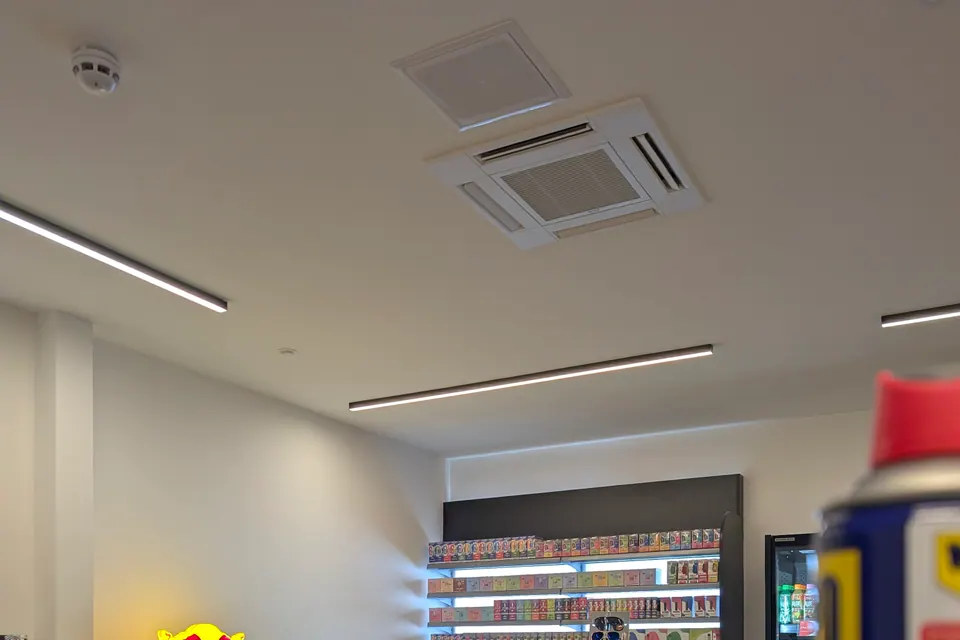
A unit described as providing 3.5 kW of cooling does not necessarily draw 3.5 kW of electricity. Cooling capacity measures how quickly heat is removed from the room; electrical input measures the power needed to do that work.
Understanding the difference is the first step towards a useful running-cost estimate. The second is recognising that an inverter system’s input changes as the room load changes. A single nameplate figure cannot predict every summer bill.
Start with power and time
Electrical energy in kilowatt-hours equals average electrical input in kilowatts multiplied by operating time in hours. For example, a system averaging 0.6 kW over five hours uses 3 kWh. Repeat that pattern for 30 days and the total is 90 kWh.
This is an illustrative usage pattern, not a prediction for a particular room or product. The assumed average must include periods of lower and higher compressor demand. It should not be confused with a nominal test-point input or the thermal capacity advertised in the model name.
Apply the right electricity price
Multiply those 90 kWh by your actual electricity rate. At an illustrative 30p/kWh, the energy cost would be £27. That price is deliberately hypothetical, not a claim about the tariff currently available to your household.
For context, Ofgem’s published table gives 26.32p/kWh as the Great Britain average Direct Debit electricity unit rate for 1 October–31 December 2026. That is not a summer forecast or a universal household rate. Regional prices, payment methods and fixed or time-of-use contracts differ.
Use specifications carefully
Manufacturer documents distinguish cooling capacity, electrical input and seasonal efficiency. Mitsubishi Electric’s MUZ-AP VG manual, for instance, lists separate capacity and power-input figures for specific pairings at defined test conditions. Those figures illustrate the distinction, not an average for every installation.
SEER compares seasonal cooling delivered with electricity used under standardised conditions. Dividing an estimated seasonal cooling requirement by an appropriate SEER can inform budgeting, but the result inherits the assumptions behind both inputs. It is not reliable to divide a room’s nominal unit capacity by SEER and assume constant hourly consumption.
Understand what changes demand
Sunlight through glazing, outdoor temperature, insulation, occupancy, computers and cooking all influence the heat that needs removing. A sunny room with open doors may have a different load from a shaded bedroom, even when their floor areas match.
Thermostat settings and schedules matter too. Selecting a much colder temperature can increase demand rather than cool the room proportionally faster. Our running-cost advice focuses on operating habits; this guide focuses on estimating consumption rather than promising a particular percentage saving.
Check more than one room correctly
With a multi-split, several indoor units share an outdoor unit. Do not add independent single-split brochure inputs and assume they describe that shared system. Ask for information covering the proposed combination and realistic simultaneous use.
For an initial budget, create low, central and high usage scenarios. Record hours, assumed average input and tariff for each. Keep the existing electricity standing charge separate unless the installation genuinely changes that charge. Maintenance may support performance, but it does not turn an uncertain estimate into a guarantee.
Measure and refine after installation
Use available controller monitoring or suitable metering to compare estimates with actual operation. Check whether an app reports measured electricity or an estimate. Whole-house smart-meter data includes other appliances, so changes cannot automatically be attributed entirely to cooling.
For homes in North London, a room-specific assessment can explain likely demand and useful monitoring options. Keep weather, settings and occupancy alongside consumption records. Over time, those observations give a stronger basis for managing comfort than assuming every cooling hour uses the same power.