
Heating & comfort
Do Air-to-Air Heat Pumps Work During Cold British Winters?
Learn how cold weather affects air-to-air heat pump output, efficiency and defrost cycles, and which winter performance questions to ask before installation.
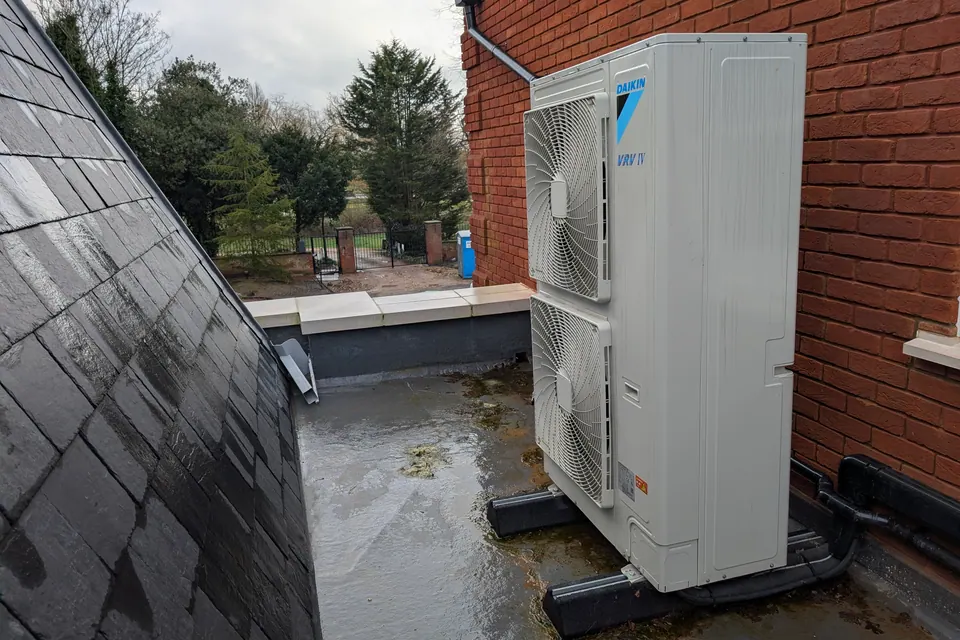
A properly selected air-to-air heat pump can provide winter heating, including when outdoor temperatures fall below freezing. The important question is not simply whether it switches on, but whether it delivers enough useful heat for your rooms at the conditions they actually experience.
That requires matching equipment performance with room heat loss. A cooling-only sizing exercise or a headline minimum operating temperature cannot establish whether a system will keep your home comfortable through winter.
Cold air still contains usable heat
In heating mode, refrigerant absorbs heat outside and releases it indoors. The compressor makes that transfer possible even when the outdoor air feels very cold. Electricity powers the process; the equipment is not simply converting each purchased unit of electricity directly into warmth.
Energy Saving Trust emphasises choosing and sizing a system for heating when that is a main requirement. As conditions become more demanding, the relationship between delivered heat and electrical input changes. Mild-weather efficiency cannot be assumed on a frosty morning.
Read the right capacity information
Manufacturers publish different figures for nominal output, maximum output, seasonal performance and operating limits. Each answers a different question. A model’s ability to operate at a low temperature does not mean its nominal heating capacity is available there continuously.
For example, Daikin’s FTXM25A2V1B/RXM25A5V1B table lists nominal heating capacity of 2.80 kW and a declared Pdh heating capacity at −10°C of 2.40 kW under its stated rating framework. These are different rating points, not a universal derating rule or a maximum-output guarantee. The installer should check the relevant tables for your actual pairing, rather than transfer one model’s figures to unrelated equipment or multi-split combinations.
Understand why defrosting happens
During heating, the outdoor coil can become cold enough for moisture to freeze onto it. Frost restricts heat transfer, so the system periodically runs a defrost sequence. Indoor heating may pause or change during that sequence; water and temporary vapour outside can be normal.
Defrost frequency depends on temperature, humidity, equipment and installation conditions. It is not governed by a universal hourly timetable. Ask how defrost is accounted for in the heating design, particularly if the unit will be the main source of warmth in a regularly occupied room.
Position the outdoor unit carefully
The outdoor unit needs the manufacturer’s airflow and service clearances. Enclosing it tightly to hide it can undermine performance. Its position should also allow defrost water to drain without creating a persistent icy patch on a path or damaging the building.
Check the unit visually from a safe position, but do not reach into fans, chip ice from coils or pour hot water over equipment. Persistent heavy icing, poor heating or repeated faults call for professional maintenance, not improvised defrosting.
Check the building as well as the equipment
Heat loss increases as the difference between indoor and outdoor temperatures widens. Insulation, glazing, draughts and room connections therefore matter alongside the model’s capacity. An indoor unit serving one room will not necessarily heat a closed bedroom down the corridor.
Our winter suitability guide covers the property questions separately. For a winter-led design, establish which rooms must remain comfortable, the target temperatures, expected hours of use and what heating remains available if the system is unavailable.
Ask for a winter-specific recommendation
Request the exact model pairing, room heat-loss assumptions, winter design temperature, relevant capacity data and an explanation of controls. Seasonal efficiency is useful for budgeting, but cannot alone prove that enough heat will be available at the coldest design condition. Ask the installer to explain any remaining uncertainty.
Aircon Elite’s air-to-air heating service can assess heating and cooling requirements together. The recommendation should make clear what the proposed equipment covers, what happens during defrost and whether any rooms or hot-water needs require a separate solution.